
1. There’s a picture of me that exists in the world that is lost to me now. Dumpling, as she was then called, is the protagonist, who’s sat plumped on her mum's bed, dolled up in an amethyst and lilac patchwork dress. It’s Dumpling's first birthday and, with her upside-down smile, she sits eying her dad, whose figure stands partially outside of the frame. Dumpling has a light brown tint to her rounded cheeks, thick arms and legs, but not her slanted eyes - those are blackish. Her cares had not yet been tainted by the world and its flaws, and while she had come out screaming like everyone else, she was christened in a sort of innocence that would carry herself and her bloodline through.
2. It had been four generations (or three: I’m still drawing my family tree) post-slavery. John Chin had been a small thing, splashing his relatives - and being splashed - in the river in the mountainous region which those who bore his name called home. He ate lots and spoke little.
He gave people the stink eye when they came too close. He even stared into the distance and thought of future me and others – his descendants – those who would sprout from him, and those who’d bear his name. With another picture, I outline the small figure of my teenage mum.
She stands legs crossed without the weight of the world on her shoulders. It brings me joy to see their faces in their various shades of golden: to see them in their youth. I, like many, have been searching for signs of resemblance, as Jennifer Nash calls it (who is, too, partly of Bajan heritage). So, when I think of that picture of Dumpling, at that specific moment in time: just before one of my many explosions when people who weren’t my mum came too close, I’m reminded that I’m a younger embodiment of my father’s grandfather and my mum.
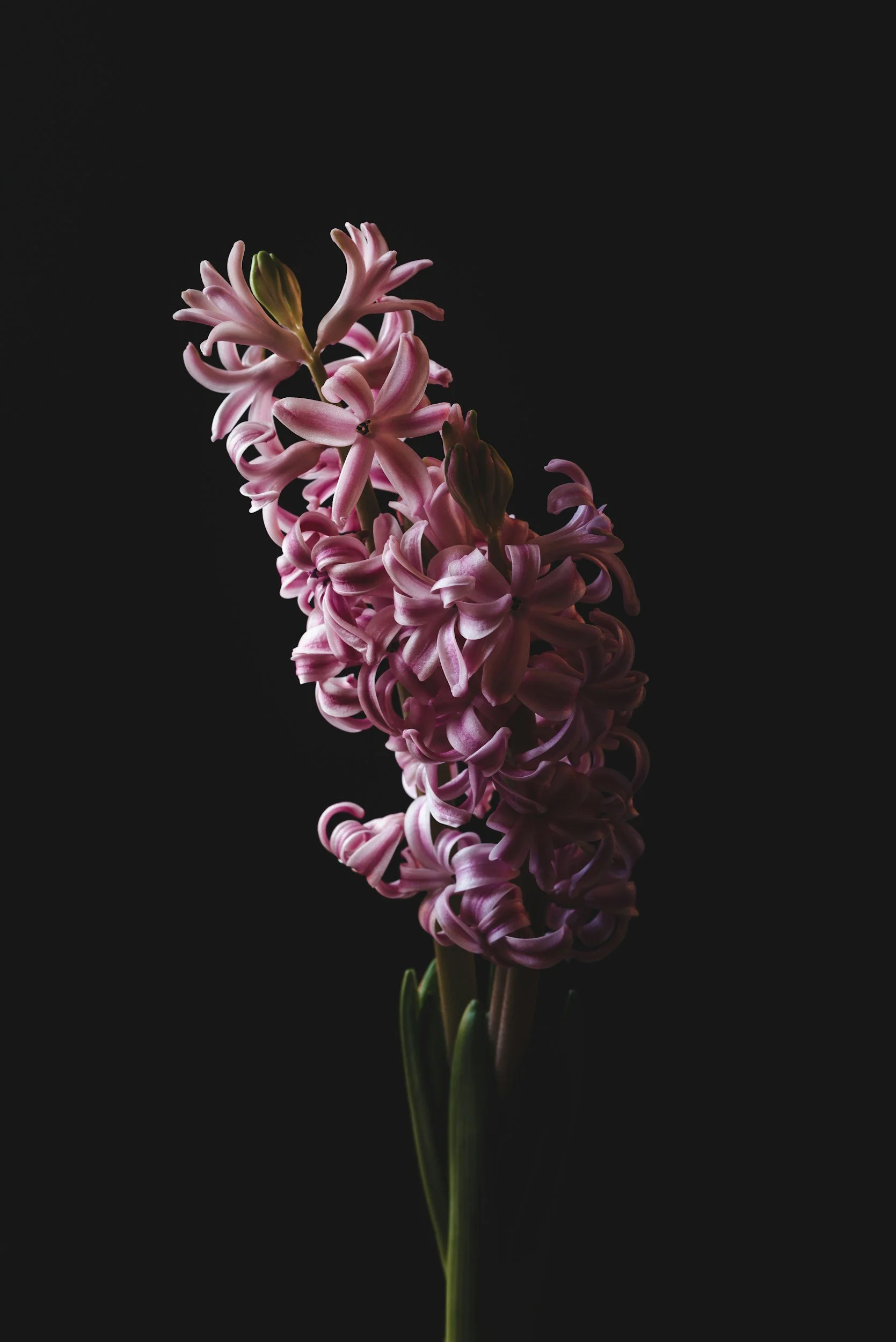
3. My work to date has continued to revolve around flowers – where my art, family histories, and anthropologies of my youth collide to frame me entirely. After all, my oldest direct forebear is named after one.
4. The hyacinth girl
She was the first drop in the ocean.
She was the grass, the sky, and the water; and she wasn’t.
The slant in her eyebrows was natural – she’d always said it was a rendering of her Creator, Who’d apparently gotten extra creative when it came to Mr Gordan's girl. Her hair, even in her old age, was the blackest brown - just like her father's; and her coils? Just like her mother's. Every day it quilted her head, and every day it would be neatly tucked under a blackened handkerchief: which she’d had it since her and his marriage, just like those petite, shaped women from whom Miss Hyacinth descended.
Her mind, calm to the senses. Her fears? There were none.
She’d never dreamt of leaving, you see, though one-by-one her ten children would reject her patchwork quilts. They’d kiss her cheek. And severe their umbilical cords. Unknowingly bruising all that she was.
Only to return on those fateful days that came every so often, but without fail.
To return only as bittersweet disappointments.
No, ever since the hyacinth girl could walk, she would carry her chubby legs as far as she could: always ending up close to the frangipani tree that cuddled her whole village. Beyond her view was nothing but cattle and autumn birds. She and what we’d today call elements would co-exist on a single plane, as though she was a natural branch of the rainforest, and the rainforest, a natural branch of her.
5. Scent-imental
It’s 2021 and I’m in my Grandma’s kitchen. —Though not really because she’s carried me past the blinds and past the hills outback that rise and fall for hours on end. Not really because I’m meant to be helping her cook. Meant to be learning traditional recipes.
Instead, I look on from a sloping chair while she prepares the many elements of her dish. A soup? I’m not sure. All I know is that although I’m the slightest of the women in the house, I’m going to be the first to hunger. The first to ask for more. The aroma tickles my nostrils, I adjust the green pillow, and I settle. We’re on a beach somewhere. Saltwater cuddles my ankles, and my welcome is accompanied by a calypso record from the fifties. I let out a lengthy breath as a young woman approaches from far and wide, appearing to saunter towards me. I blink in shock. It’s night out but I recognise everything—from the curls in her hair to the way she moves her hips: everything from the angle of her ears to her slim, arch- less feet. Who knew Grandma looked just like me? As if she can hear my thoughts, she takes her cue to sit. I move, gently, reaching to touch her face. She adjusts my arm so to cup her chin. She smiles. I inhale the dancing fragrances which paint my scene, just the same as —. It’s a laugh that shakes me back to the present day where I’m sitting on a chair in my grandma’s kitchen, staring quizzically at the pot. It’s then that I notice the silence. In all that time my grandma never uttered a word. Instead, she sits, humming to me.
6. Self-portrait (‘The Gazing Widow’), After Suchitra Bhosle’s Untitled, 2015
The year is 1959 when Bhosle first sets out to paint her sitter, a Jamaican native, who now goes by various names. Known far and wide for her charity, Miss Hyacinth would spend her mid- twenties rearing her little ones. The two frequent her mother’s land: both sewing, both roaming, both hushed. One day, wind would reach Bhosle concerning the loss of Hyacinth’s young love. It’s on learning of his death that she sits, poised in the deep silk reds, overlooking her infants’ waving arms. It’s on learning of his death that she gives way to her thoughts. Alone, unconsoled. A throbbing, broken heart.
7. I thread these recreated images of me and mine through the single black and white picture that I have of my paternal Great-Grandfather, which I carry on my person. He was a handsomeman: one that looked like those who came before, with his woolly hair and his slanted eyes.
These “gatherings” of scenes that I’ve come to inherit are much greater than any monetary value and goes beyond any expression in the Romance languages we – the exiled – grew up tracing on our tongues. Lacking the language to tell those stories but learning to do what otherwise can’t be done.
I trace the peculiarity that I’ve come to inherit – the quiet, the fire, the diligence: the overhung.
And to think that it all began with a single picture.
Written By Amouraé Bhola-Chin